
Introduction
For many visitors, the first act upon entering a Hindu temple is simple and familiar: ringing the bell at the entrance.
It happens almost instinctively. Some are told it invites blessings, others believe it removes negativity, and many simply follow tradition without asking why. Yet in the architectural and philosophical world of Hindu temples, this act is far more meaningful than a routine ritual.
The temple bell—known as ghanta in Sanskrit—is not merely a decorative object or ceremonial accessory. It represents one of the most refined ideas within Sanatan tradition: the movement from distraction to awareness.
Its sound marks a transition. Outside the temple lies the ordinary world of urgency, noise, and mental restlessness. Inside begins a different space—one of reflection, reverence, and presence.
Understanding why temple bells are rung requires looking beyond popular one-line explanations. Their purpose is rooted in temple history, Agamic ritual systems, symbolism of sound, and even the practical psychology of sacred spaces.
Like many Indian traditions, the bell is not important because it is old—it is important because it carries meaning.

Historical Origins of Temple Bells
From Vedic Rituals to Temple Worship
Early Vedic worship was centered around yajna—fire rituals performed with chants, offerings, and priestly recitation. Formal temple worship as we know it today developed more prominently in the later classical and early medieval periods, especially between the Gupta era and the rise of major temple-building traditions across India.
As temples evolved into structured spaces of public devotion, ritual systems became more elaborate. Worship was no longer limited to sacred fire; it included murti puja (deity worship), aarti, offerings, music, and ceremonial sound.
In this environment, bells became an important ritual instrument.
They joined conch shells (shankha), drums (mridanga), and cymbals as part of temple soundscapes designed to create spiritual attention.
Bells in Agama Shastra Traditions
Much of temple worship in Hindu traditions—especially Shaiva, Vaishnava, and Shakta temples—is guided by the Agama Shastras. These texts describe temple architecture, deity installation, daily rituals, and ceremonial worship.
The use of the ghanta is mentioned in these ritual frameworks as part of formal worship. Bells are rung during:
- the opening of temple worship
- aarti (offering of light)
- naivedya (food offering)
- invocation prayers
- ceremonial processions
In South Indian temple traditions especially, the bell is closely integrated into Agamic ritual procedure.
It is not an optional accessory—it is part of ritual structure.

Sacred Craftsmanship of Temple Bells
Traditionally, temple bells were carefully crafted using specific metal combinations, often involving bronze or panchaloha (a sacred five-metal alloy used in many ritual objects).
The bell’s shape, thickness, and resonance were considered important. The goal was not loudness alone, but tonal clarity and sustained vibration.
In many regions, bell-making itself was treated as sacred craftsmanship, reflecting the Indian idea that ritual objects must carry both function and symbolic intention.
The bell was made to be heard—and remembered.
Scriptural and Ritual References
The Meaning of the Ghanta in Worship
A commonly recited verse during bell-ringing says:
“Agamartham tu devanam, gamanartham tu rakshasam”
This is often understood as:
“I ring this bell to invite the divine and to remove disturbing forces.”
This verse is frequently used in ritual manuals associated with temple and household worship traditions.
However, this should not be interpreted literally as “calling gods” or “driving away demons” in a supernatural sense.
In ritual language, “rakshasas” often symbolize disturbance, distraction, and inner agitation. The purpose is psychological and spiritual: to create focus.
The bell announces intention.
It tells the mind that worship has begun.
Why Bells Are Rung During Aarti
During aarti, bells are rung alongside lamps, chants, incense, and devotional music. This creates a complete sensory environment where sight, sound, fragrance, and rhythm work together.
The purpose is not to “wake up” the deity.
In Hindu philosophy, the divine is not absent until summoned. Divinity is understood as ever-present.
Ritual exists to awaken the devotee—not the deity.
The bell is therefore an instrument of attention, not notification.
Symbolic Meaning of Ringing the Bell
Crossing the Threshold of Awareness
The entrance of a temple is both physical and symbolic.
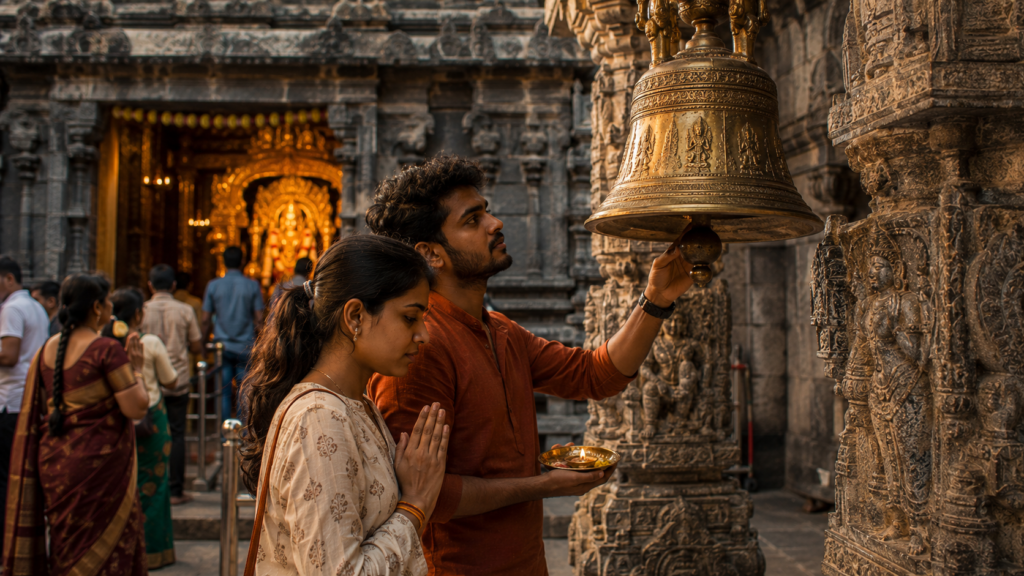
When a person rings the bell before entering, it represents leaving behind the mental noise of daily life—worry, ambition, distraction, and routine.
The sound becomes a pause.
It creates a moment between two worlds:
the outer world of activity
and the inner world of contemplation.
This is perhaps the deepest meaning of the temple bell.
It signals conscious entry.
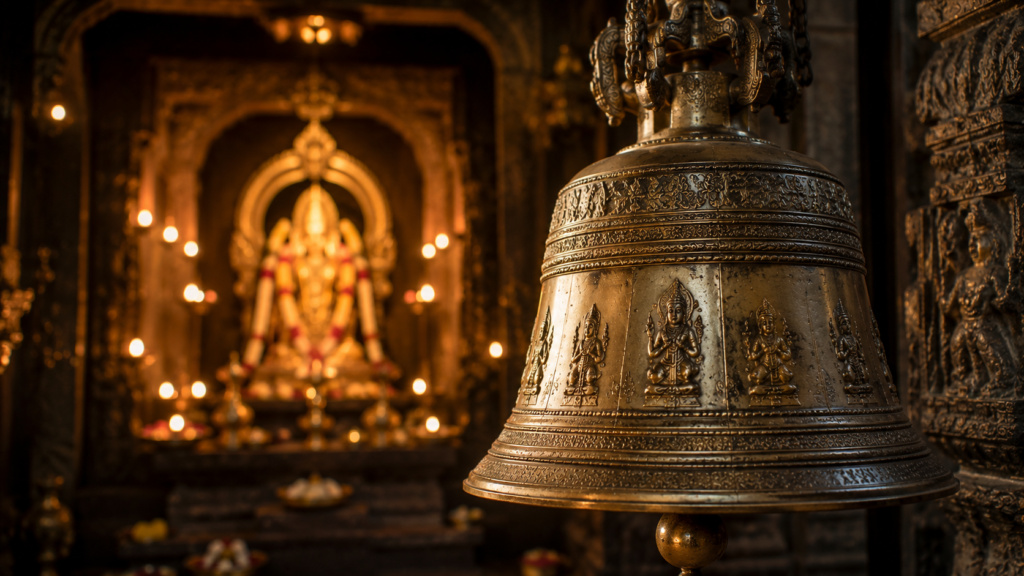
Sound as Sacred Presence
Indian philosophical traditions place extraordinary importance on sound.
The idea of Nada Brahma—“the universe is sound”—reflects the belief that vibration and consciousness are fundamentally connected.
Sacred syllables like Om are not treated merely as words, but as expressions of cosmic order.
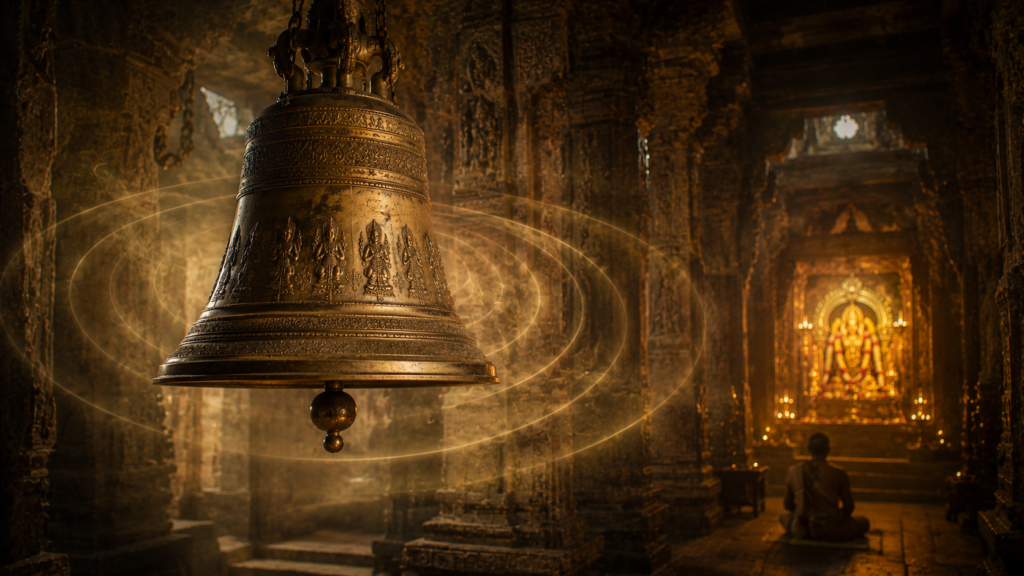
In this context, the temple bell is not random sound. Its resonance symbolizes continuity, clarity, and spiritual attention.
Its purpose is not entertainment.
It is alignment.
The sound invites stillness.
Scientific and Practical Interpretations
Sound and Human Attention
From a practical perspective, a clear bell sound immediately interrupts mental wandering.
Modern psychology recognizes that sound cues can shift attention and create present-moment awareness. This is why meditation traditions across cultures often use bells, chimes, or gongs.
Temple bells work in a similar way.
They help the devotee arrive mentally, not just physically.
The act is simple, but its effect is significant: it creates intentional presence.
Temple Acoustics and Spatial Design
Traditional Indian temples were designed with careful attention to sound.
Stone walls, enclosed sanctums, pillared halls, and open courtyards allowed sound to travel, echo, and linger. The bell’s resonance became part of the temple’s architectural experience.
This was not “miracle science,” but sophisticated environmental design.
Sound shapes atmosphere.
Atmosphere shapes emotion.
Emotion shapes attention.
That is the practical intelligence behind the ritual.
Common Misconceptions vs Authentic Understanding
Misconception 1: The Bell Removes All Negative Energy
This is one of the most repeated claims online, and often the least explained.
When presented as guaranteed magical protection, it weakens both cultural understanding and credibility.
A better interpretation is symbolic purification.
The sound helps clear mental clutter and creates a respectful state of mind.
The “negative energy” is often internal distraction—not a mystical force floating in the room.
Misconception 2: God Must Be Alerted
Some people are told that the bell is necessary to inform the deity of their arrival.
This oversimplifies Hindu philosophy.
Divinity is not sleeping until awakened by noise.
The bell is for the worshipper.
It marks awareness, humility, and intention.
It prepares consciousness for darshan.
Misconception 3: Without Ringing the Bell, Blessings Are Incomplete
Devotion is not measured by mechanical ritual performance.
Not every temple requires a bell to be rung, and spiritual sincerity cannot be reduced to ritual checklists.
Understanding matters more than habit.
Tradition becomes meaningful when practiced with awareness—not fear.
Why This Tradition Still Matters Today
A Form of Ritual Mindfulness
Modern life is built around speed, interruption, and constant mental noise.
In such a world, even a few seconds of deliberate pause have value.
Temple bells preserve that pause.
They remind people that spirituality is not only belief—it is attention.
The act of ringing the bell becomes a form of ritual mindfulness rooted in tradition.
It asks a simple question:
Are you truly present?
Cultural Continuity and Living Heritage
Temple rituals also preserve civilizational memory.
For younger generations, understanding why traditions exist is essential. Without meaning, rituals become empty habits. With meaning, they become living culture.
The bell connects architecture, philosophy, craftsmanship, music, and devotion in one action.
It carries memory across generations.
That is not superstition.
That is cultural continuity.
Conclusion
Temple bells are rung in Hindu temples not because they possess magical powers, but because they represent one of the oldest principles of sacred life: conscious presence.
Their history lies in temple architecture and Agamic ritual systems. Their symbolism emerges from Indian philosophical ideas about sound and awareness. Their practical effect is rooted in attention, focus, and emotional transition.

The bell does not “bring God closer.”
It helps the devotee become more present.
And perhaps that is the real wisdom behind the tradition:
before entering a sacred space outside,
one must first create a sacred space within.