Every year, on the day after the main Diwali celebration in the month of Kartik, Hindus observe Govardhan Puja—a festival that mixes devotion, food, nature-worship, and a powerful myth of protection. On this day, devotees remember the story of how Lord Krishna lifted the hill of Mount Govardhan to shield the people and cattle of Braj (Vrindavan) from torrential rains unleashed by Lord Indra. The festival’s central motif is the “Annakut” or “mountain of food,” symbolizing gratitude for earth’s bounty and the protective power of the divine.
The Myth and Its Scriptural Foundation
According to the sacred tradition, the inhabitants of Braj regularly offered worship to Indra, the god of rain, to secure showers and good harvests. Young Krishna questioned this ritual, proposing instead that the locals honour Mount Govardhan, for it fed their cattle, supplied grass and sustained life. Indra, offended, sent a devastating storm. In response, Krishna lifted the mountain on his little finger and held it aloft for seven days, protecting the village, its people and its livestock until Indra realised his error and bowed to Krishna’s supremacy.
Scriptural accounts—such as those in the Bhagavata Purana—present this event as a pivotal moment of humility, devotion and nature-veneration. Followers of Krishna quote lines such as:
“Girirāja tvam aham aham tvam girirāja”
(I am the mountain, you are the mountain – symbol of unity with the divine).
By recognising the hill as divine, the story teaches that the divine dwells in nature and sustains life.
Why the Festival Is Celebrated
Govardhan Puja holds deep multi-layered significance:
- Gratitude to Nature and Earth: By worshipping the hill that sustains life, devotees acknowledge the earth’s role.
- Devotion over Ritual: Krishna’s act emphasises sincere devotion more than grand external rituals.
- Protection and Humility: The narrative highlights divine protection and the collapse of ego (Indra’s fall).
- Food and Abundance: The Annakut offering of food symbolises the harvest, abundance and sharing.
- Environment and Cow-Worship: Cows, grasslands, rain-clouds and ecological interdependence come alive in the ritual.
The Rituals — What Happens on Govardhan Puja
- Preparation of the Symbolic Mountain: Devotees create a replica of Mount Govardhan using cow-dung, clay or soil, often decorated with grass, flowers, toys of cows and calves, little huts and figurines.
- Annakut (Mountain of Food): A large variety of vegetarian dishes—sometimes 56 (Chappan Bhog) or more—are prepared and offered to Krishna and the symbolic hill. The food is then distributed as prasād.
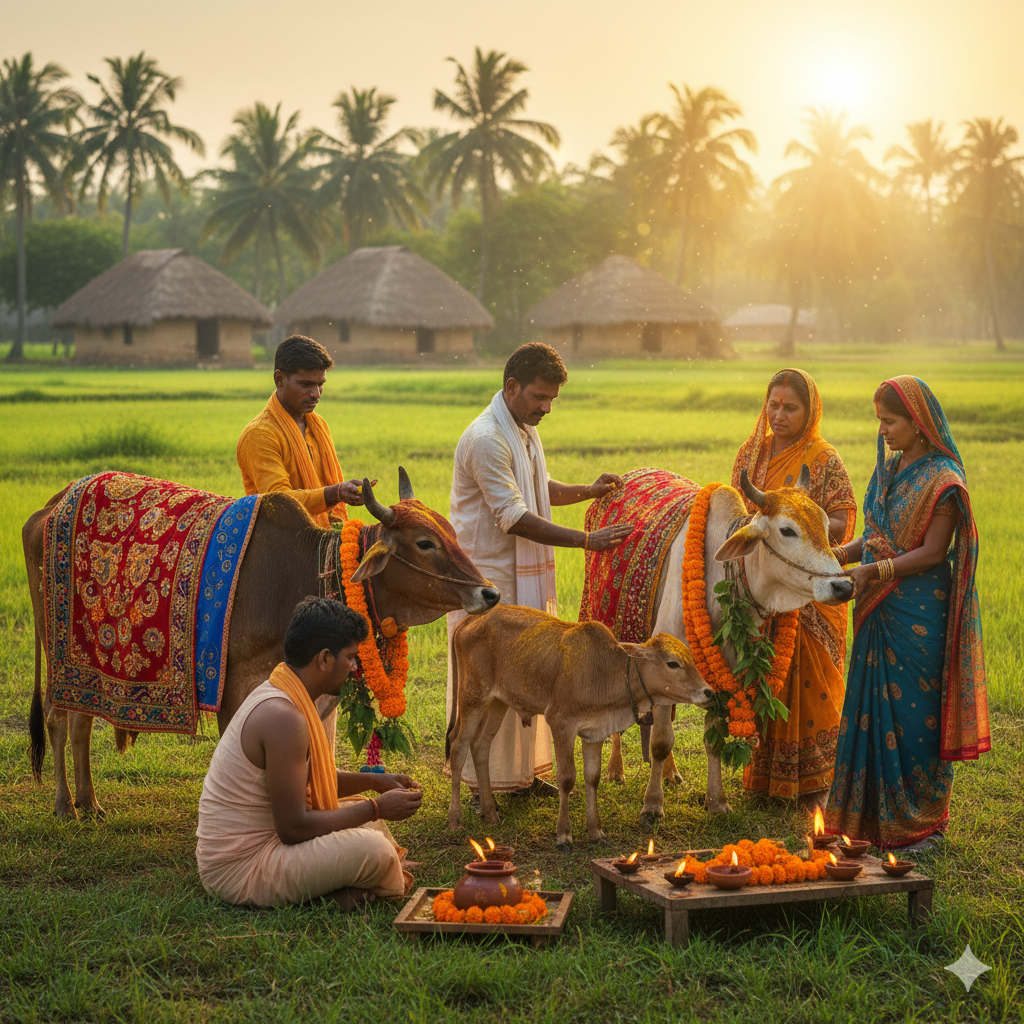
- Cow Worship: Cows and calves are bathed, decorated, fed and honoured as part of the ritual, recognising their sacred role in Krishna’s childhood pastimes.
- Aarti and Prayer: Lamps are lit, hymns and bhajans are sung, and the hill and food offering are worshipped with devotion.
- Govardhan Parikrama: At places like Vrindavan, many devotees undertake a walking pilgrimage around the actual Mount Govardhan (about 21 km) as an act of devotion and remembrance.
- Nature and Community Focus: In recent times, the festival has also emphasised environmental care, cow-protection, organic farming and community sharing.
Regional and Cultural Variants
While the core story remains constant, the forms of celebration vary:
- In Mathura–Vrindavan and ISKCON temples the Annakut is elaborately displayed, and huge crowds gather for the parikrama.
- In many towns, smaller versions of the hill are created in temple courtyards or homes, with local dishes featured.
- In Maharashtra the same day often aligns with Bali Pratipada or Bali Padva, marking other mythic memories.
- The festival has merged with local harvest-celebrations, food-sharing traditions and cow-welfare rituals, bringing new social relevance.

Contemporary Relevance — Nature, Food Security and Ecology
In modern India the ritual appeal of Govardhan Puja resonates with issues of environmental sustainability: recognition of earth’s resources, protection of cattle, respect for the ecology of grasslands and rain cycles. Government and social drives increasingly use the festival’s message—“honour nature, not just gods”—to promote cow welfare, organic farming and ecological awareness.
Comparing with Other Festivals
- Harvest & Food-Offering Festivals: Similar to Korea’s Chuseok or North America’s Thanksgiving, Govardhan Puja centres on food offerings and gratitude.
- Nature-Worship Festivities: Parallels exist with festivals that honour rivers, hills or land in indigenous traditions worldwide—yet Govardhan’s myth adds the dimension of protective divine intervention.
- After-Diwali Timing: Much like how Western festivals follow seasons (Halloween → All Saints), Govardhan follows Diwali in the Hindu calendar—linking light, thanks and renewal in sequence.
Govardhan Puja is far more than a ritual. It is a vibrant story of devotion, protection, humility and nature’s bounty. With the symbolic mountain of food, the worship of cows, the reverence for earth and the mythic act of divine rescue, the festival merges myth and ecology, faith and food. On this day, when devotees bow to the symbolic hill and share abundance, they echo the ancient truth: we are nourished by a living earth—and when we remember that, we honour the divine in everyday life.